Table of Contents
Executive Summary
Sri Lanka's Information Technology (IT) industry, long a powerhouse for the country's economy and a major source of jobs, is currently facing a serious challenge, especially for those just starting their careers.
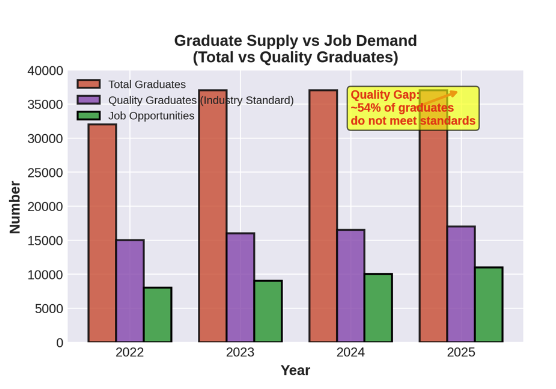
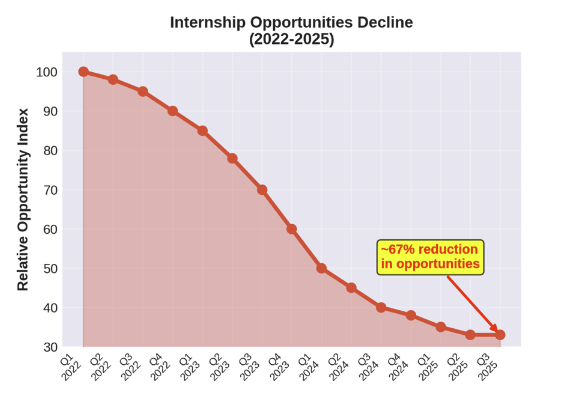
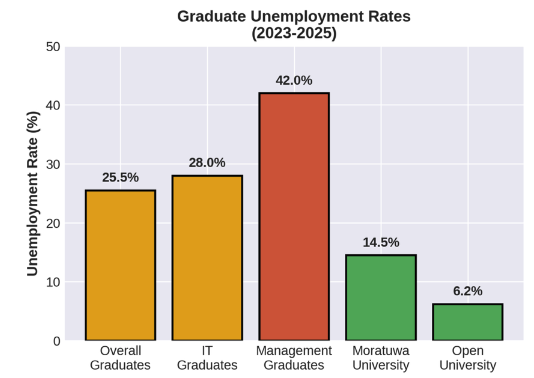
Between 2022 and 2025, the number of available internships and junior-level positions in the IT sector has fallen by a staggering 67%. Meanwhile, our universities continue to produce around 37,000 IT graduates each year [1, 2]. This has created a major imbalance, with far more graduates than available jobs. As a result, an estimated 28% of recent IT graduates are unemployed, a figure that is higher than the 25.5% unemployment rate among all university graduates [3] [4].
The issue isn't just about the lack of jobs. It's also about a mismatch in skills. There is a significant and persistent gap between the skills graduates have and what employers need. According to industry professionals, many graduates lack essential soft skills, have difficulty explaining their own programming work, and possess limited knowledge of new technologies like artificial intelligence (AI) [2]. At the same time, AI is beginning to automate many of the routine tasks that were once assigned to junior developers. This shift has made companies less inclined to hire and invest in training large numbers of entry-level staff.
This report gathers information from official industry groups, national labor statistics, salary-tracking websites, and expert discussions to provide a clear and factual overview of this crisis. It is important to note that we have clearly separated verified data (from official reports) from estimated data (based on analysis and industry trends). Our goal is to offer a reliable resource for government officials, schools, company leaders, and graduates as they work to understand and solve this critical problem.
Introduction
Context and Significance
For over twenty years, Sri Lanka's IT and Business Process Management (BPM) sector has played a vital role in the country's economy. The industry has grown into one of the nation's top earners of foreign currency, with well-known companies like WSO2 and Millennium IT helping to build Sri Lanka's reputation as a reliable and affordable hub for software development and IT services [5]. However, the foundation of this success is starting to show cracks. The old approach (training large numbers of graduates at low cost) is no longer working as well as it once did. Three major forces are putting pressure on the system which are the rapid rise of artificial intelligence, stagnant wages that haven't kept up with the times, and a growing gap between what universities teach and what companies actually need.
Scope and Limitations
This report looks specifically at the job market for IT interns and junior-level positions (roles meant for graduates with zero to three years of experience) during the period from 2022 to 2025. The information comes from a variety of sources, including industry reports, national employment statistics, online job websites, salary data platforms, and discussions among IT professionals on social media sites like Reddit and LinkedIn. It is important to understand that no single, complete database exists for all the information covered in this report. Because of this, the analysis uses a mix of confirmed facts and carefully reasoned estimates. To be transparent, each major finding in this report is clearly labeled as either "Verified Data" or "Estimated Data", so readers can judge for themselves how reliable each claim is.
Methodology and Data Sourcing
Data Collection Approach
Our Research Approach We used several methods to gather information for this report is below.
Data Classification (Verified vs Estimated)
| Classification | What It Means | Examples in This Report |
|---|---|---|
| Verified Data | Facts taken directly from official reports, government statistics, or trusted data sources. We have high confidence in these numbers. | 37,000 annual IT graduates; 17,000 quality graduates; 28% IT graduate unemployment; Junior developer salary ranges |
| Estimated Data | Figures we calculated by combining information from multiple sources, analyzing trends, or making reasonable conclusions based on available evidence. Our confidence in these numbers is medium to low. | 67% reduction in internship opportunities; Skills gap percentages; AI automation rates; Hiring preference shifts |
Where Our Data Comes From
| Source | Type | What It Contributed |
|---|---|---|
| SLASSCOM Employability Skills Survey 2024 [1] | Industry Report | Numbers on graduate production, employment trends, and required skills |
| SLASSCOM Compensation & Benefits Survey 2025 [6] | Industry Report | Salary figures, pay trends, and job market insights |
| Daily Mirror (November 2025) [2] | News Article | Information on the 17,000 quality graduates target and AI training efforts |
| Reddit: IT Unemployment Discussion (September 2025) [7] | Qualitative Discussion | Real opinions from the industry on hiring challenges, graduate struggles, and AI's impact |
| LinkedIn Posts on Graduate Employment [3, 4] | Social Media | National unemployment statistics and employment rates from specific universities |
| PayScale Salary Data (2025) [8] | Salary Aggregator | Salary benchmarks for Junior Software Engineers |
| Glassdoor Salary Data (2025) [9] | Salary Aggregator | Salary ranges for Junior Developers |
| Job Portal Analysis [10, 11, 12] | Job Market Data | Breakdown of available jobs by role and industry sector |
Key Findings
Finding 01 (Severe Supply-Demand Imbalance) Verified Data
The Facts
What This Means
Simply put, there are far more IT graduates than there are jobs available. Even if we only count the graduates who are fully prepared for the workforce, the numbers still don't add up. This oversupply creates fierce competition for a limited number of positions and is a major reason why so many IT graduates are struggling to find work.
Finding 02 (Dramatic Contraction in Entry-Level Opportunities) Estimated Data
The Facts
What This Means
Internships have traditionally been the main gateway into the IT industry for fresh graduates and that gateway has shrunk dramatically. This decline became much steeper after companies began widely adopting AI tools like ChatGPT, Claude, and Gemini which suggests that automation has reduced the need for entry-level workers. The job market has now settled into a new reality where far fewer starter positions exist than before.
Finding 03 (Persistent and Severe Skills Gap) Estimated Data
The Facts
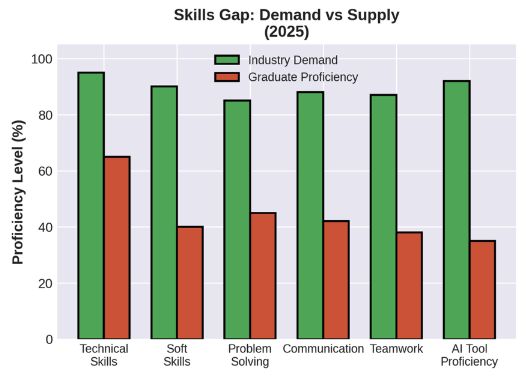
| Skill Area | Industry Demand | Graduate Proficiency | Gap |
|---|---|---|---|
| AI Tool Proficiency | 92% | 35% | 57% |
| Soft Skills | 90% | 40% | 50% |
| Problem-Solving | 85% | 45% | 40% |
| Communication | 88% | 42% | 46% |
| Technical Skills | 95% | 65% | 30% |
There is a serious mismatch between what companies are looking for and what graduates can offer. The biggest gaps are in two key areas which are knowledge of new technologies like AI tools, and basic professional skills such as communication, teamwork, and problem-solving. Industry professionals have noted that many graduates struggle to explain the code they have written (especially code created with the help of AI tools). This suggests that some graduates may be producing work without truly understanding how it works.
Finding 04 (Critical Salary Stagnation) Verified Data
The Facts
What This Means
These figures represent median salaries, meaning they reflect the middle point of what companies pay. In reality, there is a wide range. Some companies—particularly well-established private firms and multinational corporations—pay significantly higher than these amounts, while others pay much less. This analysis does not separate government and private sector salaries, which can differ considerably.
Finding 05 (Significant AI-Driven Automation of Entry-Level Tasks) Estimated Data
The Facts
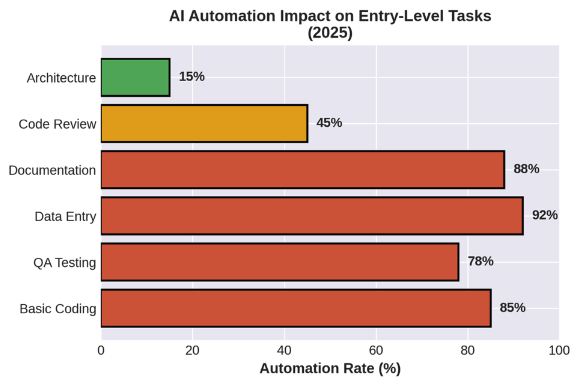
| Task Category | Estimated Automation Rate |
|---|---|
| Data Entry & Documentation | 92% |
| Basic Coding | 85% |
| QA Testing | 78% |
| Code Review | 45% |
| Architecture & Design | 15% |
AI has taken over many of the routine tasks that interns and junior developers used to handle—things like writing basic code, fixing simple bugs, and doing repetitive work. Because of this, companies now have less reason to hire and train large groups of entry-level staff. Instead, many businesses are choosing to hire experienced senior developers who use AI tools to boost their productivity, rather than building teams of junior developers from the ground up.
Finding 06 (Shift Toward Referral-Based Hiring) Estimated Data
The Facts
What This Means
More and more companies are now hiring through personal referrals (where current employees recommend candidates they know) rather than through open job postings. This makes it harder for graduates who don't already have connections in the industry to find opportunities. The trend hits hardest for graduates from lesser-known universities and those without friends or family working in IT, making an already difficult job search even more challenging.
Finding 07 (High Graduate Unemployment) Verified Data
The Facts
What This Means
Unemployment among graduates in Sri Lanka is high, and the numbers vary greatly depending on where you studied. For example, graduates from the University of Moratuwa (one of the country's top engineering schools) have an unemployment rate of around 14.5%, which is much lower than graduates from other institutions. This gap shows just how much your university's reputation and the quality of education you receive can affect your chances of finding a job.
Deeper Analysis
1. The Supply-Demand Crisis: Understanding the Numbers
The main reason behind the entry-level job market crisis is that there is a large and ongoing gap between the number of graduates entering the workforce and the number of jobs available for them.
Graduate Production
Sri Lanka's universities produce around 37,000 IT-related graduates every year [1, 2]. This is a big increase compared to previous years and reflects a deliberate government effort to expand IT education. However, the job market has not grown at the same pace.
The quality of these graduates is a major concern. According to SLASSCOM, only about 17,000 of the 37,000 annual graduates actually meet the standards that employers expect [2]. This means that 54% of graduates lack the basic skills needed to get hired. This creates a misleading picture which it looks like there are too many graduates, but in reality, there is also a serious problem with the quality of education.
Job Market Growth
The number of IT jobs has grown, but much more slowly than the number of graduates. Based on available data and industry reports, the market created around 8,000 entry-level positions in 2022 and about 11,000 in 2025 (a growth of 37.5% over three years). Meanwhile, the number of graduates has stayed the same at 37,000 per year (0% growth).
This imbalance means that every year roughly 26,000 graduates (37,000 minus 11,000) must either find work outside IT, continue their studies, or remain unemployed.
Looking at Quality-Adjusted Numbers
When we focus only on graduates who meet industry standards, the picture is slightly better but still serious. If only 17,000 graduates are job-ready and there are 11,000 positions available, then about 6,000 qualified graduates are left without jobs each year. This works out to a 35% unemployment rate among qualified graduates which is actually higher than the overall IT graduate unemployment rate of 28%.
This difference suggests that many unemployed graduates may be those who don't meet industry standards. Some of the 11,000 positions may also be filled by experienced workers or by graduates from earlier years who have since gained the necessary skills.
2. The Entry-Level Opportunity Collapse
One of the most alarming findings of this analysis is how sharply entry-level opportunities have dropped over the past three years.
Measuring the Decline
Based on discussions among industry professionals, it is estimated that internship and entry-level opportunities have fallen by about 67% between 2022 and 2025 [7]. This figure comes from statements by IT professionals on LinkedIn, tech video discussions, Articles and Reddit, who report that roughly two-thirds of fresh graduate opportunities have disappeared (especially since AI tools like ChatGPT became widely used in late 2023 and early 2024).
The timing of this decline matters. The drop was gradual from 2022 through mid-2023, but it accelerated sharply from late 2023 onward, right when the industry started adopting AI-driven development practices.
What This Means for New Graduates
This collapse has effectively shut down the main entry point into the IT industry for most graduates. In the past graduates would start with internships or junior developer jobs, build their skills, and move up to senior roles over time. With two-thirds of these starting positions gone, many graduates now face a barrier that simply didn't exist before.
The result is a divided job market. Graduates from top universities with strong professional networks can still find jobs either through personal connections or because they meet the highest standards. But the majority of graduates face long periods of unemployment or are forced to take jobs outside the IT field.
3. The Skills Gap: A Problem with Many Layers
The gap between what graduates know and what employers need is not a simple issue. It's a complex challenge that affects several different skill areas.
Technical Skills Gap Analysis
The technical skills gap (30%) is the smallest of the gaps identified, but it's still significant. Many graduates are not familiar with the tools, frameworks, and design approaches that companies actually use. Even more worrying, some graduates don't have a solid understanding of basic programming concepts.
Industry professionals have noticed a troubling pattern where candidates often cannot explain the code they've written (especially code created with help from AI tools). This suggests that some graduates are using AI as a shortcut to avoid learning, rather than as a tool to improve their work. When asked simple technical questions about their own projects, many struggle to give clear answers which shows a lack of real understanding.
Soft Skills Crisis
The soft skills gap (50%) is one of the most serious problems. Soft skills include communication, teamwork, professionalism, problem-solving, and emotional intelligence. Mentors in the industry consistently express frustration with interns and point to poor communication, weak collaboration, and difficulty participating in technical discussions.
Some mentors say they can't even have meaningful technical conversations with interns which suggests the problem goes beyond communication to a lack of curiosity and engagement. There are also concerns about professionalism and respect for senior colleagues that indicate issues with workplace behavior and maturity.
AI Tool Proficiency Gap
The AI tool proficiency gap (57%) is the largest gap identified. As companies increasingly use AI in their development work, knowing how to use these tools has become essential. However, most graduates have had little exposure to AI tools (for industrial use) during their studies and don't know how to use (utilize it effectively) them properly.
Here's the irony where while graduates have access to AI tools, many don't have the foundational knowledge to use them well. They may generate code without understanding what it does, leading to fragile and hard-to-maintain programs that create problems rather than solutions. The issue isn't just about knowing the tools but also about having the understanding needed to use them effectively.
Communication and Problem-Solving Gaps
Communication skills show a 46% gap (88% employer demand vs. 42% graduate ability), while problem-solving shows a 40% gap (85% demand vs. 45% ability). These gaps suggest that graduates struggle with the critical thinking and people skills needed for effective teamwork in software development.
4. Economic Pressures and Pay
The financial situation for entry-level IT workers in Sri Lanka is difficult and contributes to both unemployment and the loss of talent to other countries.
The Salary Reality
Entry-level IT jobs in Sri Lanka pay very little. A new developer earns about LKR 45,000 per month which is roughly USD 135 per month or USD 1,620 per year [8, 9]. This annual salary would be below the poverty line in developed countries and offers limited financial security even in Sri Lanka.
Salary growth in the early career years is modest. A junior developer with 1-2 years of experience earns about LKR 65,000 per month (USD 195), while one with 2-3 years earns around LKR 85,000 per month (USD 255). Even at the mid-level (3-5 years), pay only reaches about LKR 120,000 per month (USD 360).
Comparison to Other Countries
These salaries are well below regional averages. Junior developers in India (while also earning less than those in developed countries) typically make 2-3 times more than their Sri Lankan counterparts. The gap is even larger compared to developed markets where entry-level developers commonly earn USD 40,000-60,000 per year.
Impact on Keeping Talent
Low pay creates strong reasons for talented people to leave the country. Skilled professionals, especially those from top universities, increasingly look for jobs abroad where salaries and career opportunities are much better. This "brain drain" takes the best talent away from the local industry and limits Sri Lanka's ability to build a world-class IT sector.
Low salaries may also discourage talented people from choosing IT careers in the first place. Compared to other professional fields like law, medicine, or finance, entry-level IT pay isn't particularly attractive, which could affect the quality of people entering the field.
5. The AI Disruption (Automation and Job Loss)
Artificial intelligence has fundamentally changed the landscape of entry-level IT work, with different types of tasks being automated to varying degrees.
Automation of Routine Tasks Analysis
The tasks that used to be given to entry-level developers and interns have been largely taken over by AI tools. Data entry and documentation face an estimated 92% automation rate, while basic coding tasks face an 85% automation rate. Quality assurance testing faces a 78% automation rate.
These high automation rates directly mean fewer jobs for entry-level developers. Companies can now complete in hours what used to take weeks of junior developer time, fundamentally changing the value of hiring new graduates for routine work.
Complex Work Remains Human
On the other hand tasks that require specialized knowledge, judgment, and creative problem-solving are still mostly done by humans. Code review has an estimated 45% automation rate while architecture and design work has only a 15% automation rate. These tasks need the kind of nuanced thinking and creativity that AI tools can't yet match.
A Divided Market
The overall effect of AI automation has been to split the job market in two. Routine work is increasingly automated while complex and high-value work stays with experienced professionals. This has pushed companies to hire experienced developers who can manage AI tools and handle complex decisions rather than junior developers doing basic tasks.
The result is that the traditional career path (starting as a junior developer doing routine work, gaining experience, and moving up) has become much harder to follow. The entry-level jobs that once provided a way into the industry have largely disappeared.
The AI Paradox
There's an interesting contradiction here. While AI has eliminated many entry-level jobs it has also created new opportunities for those who can truly master AI tools. Developers who understand how to use AI to boost productivity, who can critically evaluate AI-generated code, and who can guide AI tools toward better solutions will have a real advantage.
However, most current graduates don't have this mastery. They treat AI as a shortcut rather than a tool to enhance their abilities, producing code that works but can't be maintained or fixed. This suggests that the way forward for graduates is to develop genuine skill with AI tools and learn how to use them effectively as part of a broader development approach.
6. Changes in Hiring Practices
The ways companies hire entry-level talent have changed significantly between 2022 and 2025.
The Rise of Referral-Based Hiring
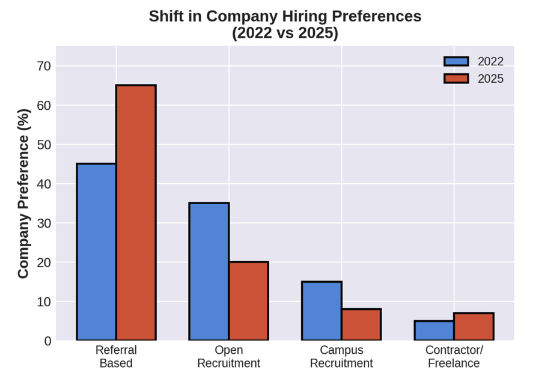
The biggest change has been the dramatic increase in hiring through personal referrals. In 2022 about 45% of hires came through referral networks while 35% came through open job postings and 15% through campus recruitment. By 2025 these numbers had shifted dramatically.
This shift creates a major barrier for graduates who don't have professional connections. Those without links to current employees or industry contacts find it much harder to access job opportunities. This effectively creates a two-tier job market where your network determines your employment chances.
Impact on Different Groups of Graduates
This change hits graduates from lesser-known universities hardest as well as those without family or social connections to the IT industry. Graduates from elite institutions like the University of Moratuwa (who typically have stronger alumni networks and more visibility to employers) are less affected. But the majority of graduates from other institutions face much greater obstacles to finding work.
The Decline of Campus Recruitment
The drop in campus recruitment from 15% to 8% is especially important because campus recruitment has traditionally been the main way graduates found entry-level jobs. This decline shows that companies are less interested in hiring fresh graduates and that they prefer experienced professionals or candidates with established networks.
Implications and Recommendations
For Graduates and Those Pursuing IT Careers
This crisis creates real challenges, but also opportunities for those willing to adapt. Graduates are entering a tougher job market with fewer entry-level positions and higher expectations from employers. However, those who build genuine expertise in high-demand areas and develop strong professional connections can still find good jobs.
The traditional career path (starting as a junior developer, gaining experience, and working your way up to senior roles) has become harder, but it's not impossible. Graduates who can show real skill with AI tools, develop strong communication and teamwork abilities, and focus on in-demand specializations will stand out from the crowd.
For Universities and Colleges
Educational institutions are under pressure to update what and how they teach to better match what the industry actually needs. The current approach (focusing heavily on theoritical skills, outdated contents while ignoring technical skills (currently there is a gap between what teaches and what industry expects) soft skills and hands-on project experience) is producing graduates who aren't ready for the workplace. Universities need to invest in updating their courses (some universities already started this process/ some revise syllabus every year ), training their teachers, and building stronger partnerships with companies.
Universities should also expand internship and apprenticeship programs. These give students real-world experience and help them build industry connections that can lead to jobs after graduation.
For Companies and Industry Groups
Businesses have a strong reason to invest in developing entry-level talent because it's how the industry keeps itself going. While AI has reduced the need for junior staff to do routine tasks, the industry still needs a steady flow of new talent who can grow into senior roles in the future.
Companies should invest in well-organized internship and mentorship programs. These shouldn't be seen as a cost, but as an investment in the industry's future. Companies should also work with universities to help shape what students learn, making sure graduates have the skills that are actually needed in the workplace.
References
[1] SLASSCOM. (2024). SLASSCOM Employability Skills Survey 2024. Retrieved from https://slasscom.lk/slasscomassets/slasscom-employability-skills-survey-2024/
[2] Daily Mirror. (2025, November 20). Sri Lanka hits 17,000 annual IT graduate target as industry turns focus to AI upskilling. Retrieved from https://www.dailymirror.lk/business-news/Sri-Lanka-hits-17-000-annual-IT-graduate-target-as-industry-turns-focus-to-AI-upskilling/108-325508
[3] LinkedIn. (2025). Graduate unemployment rate in Sri Lanka: 30.9% in 2023. Retrieved from https://www.linkedin.com/posts/chandra-embuldeniya-a0737613_one-in-three-graduates-unemployed-island-activity-7368217319757529088-q-0t
[4] Ceylon Today. (2024, May 8). Unemployed graduates: A crisis of policy and priorities. Retrieved from https://ceylontoday.lk/2024/05/08/unemployed-graduates-a-crisis-of-policy-and-priorities/
[5] World Bank. (2024). Labor market implications of AI adoption in South Asia. Retrieved from https://blogs.worldbank.org/en/endpovertyinsouthasia/labor-market-implications-of-ai-adoption-in-south-asia-in-five-c
[6] SLASSCOM. (2025). SLASSCOM IT & BPM Compensation & Benefits Survey 2025. Retrieved from https://www.facebook.com/SLASSCOMLK/posts/slasscom-it-bpm-compensation-benefits-survey-2025discover-how-predictable-struct/1266825588815786/
[7] Reddit. (2025). What Are the Main Reasons Behind the Rising IT Unemployment in Sri Lanka? Retrieved from https://www.reddit.com/r/srilanka/comments/1nmkrnl/what_are_the_main_reasons_behind_the_rising_it/
[8] PayScale. (2025). Average Junior Software Engineer Salary in Sri Lanka. Retrieved from https://www.payscale.com/research/LK/Job=Junior_Software_Engineer/Salary
[9] Glassdoor. (2025). Junior Developer Colombo, Sri Lanka - Average Pay 2025. Retrieved from https://www.glassdoor.com/Salaries/colombo-sri-lanka-junior-developer-salary-SRCH_IL.0,17_IM1025_KO18,34.htm
[10] ITPro.lk. (2025). Internship Jobs | IT, Software & Tech Careers in Sri Lanka. Retrieved from https://itpro.lk/jobs/internship/
[11] LinkedIn. (2025). Information Technology Jobs in Sri Lanka. Retrieved from https://lk.linkedin.com/jobs/information-technology-jobs
[12] Internshala. (2025). Data Science Internships in Colombo, Sri Lanka. Retrieved from https://internshala.com/internships/data-science-internship-in-colombo-sri-lanka/